
Gut Plutowo
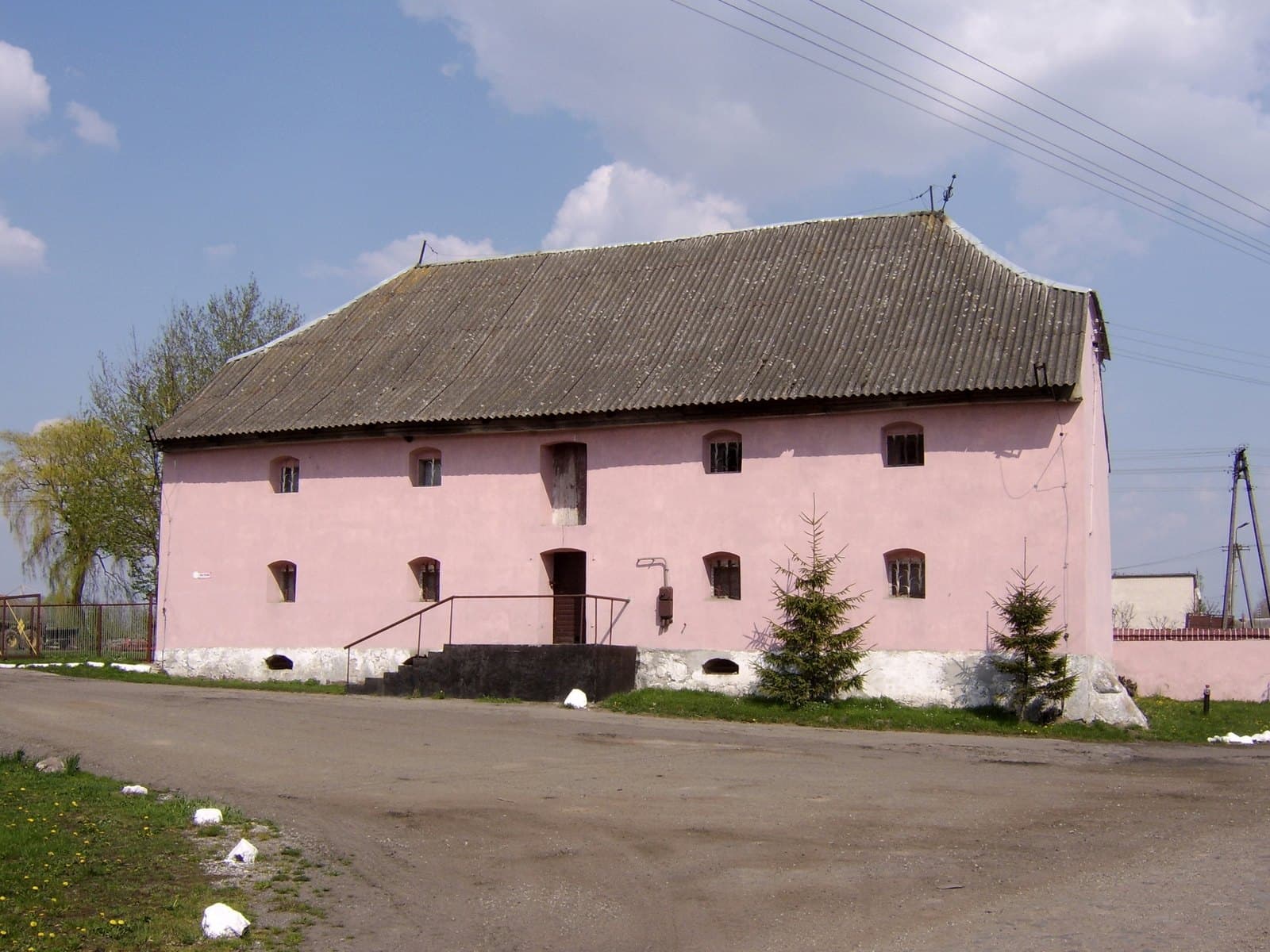
Jan Chmielewski, Wikimedia Commons, CC BY-SA 3.0 PL
An estate the family never owned and yet held for twenty years. Plutowo in the district of Kulm was a Kröcher estate, “since 1806” according to the Brünn pocketbook. It came to Jakob von Gerlach in the late 1880s out of his father-in-law’s estate; his marriage to Ida Sophie von Kröcher was childless, and it went no further. Whoever reads only the Brünn volume of 1892 takes it for a family estate; it was a possession for one lifetime.
Chronicle
- 1776 to 18191776 to 1819
The mortgage book
The state archive at Thorn holds the supplementary files to the estate’s mortgage book, and they reach further back than anything else: “Supplementary files to the mortgage book of the noble estate of Plotowo No 130 in the Culm district”, volume I for 1776 to 1787 and a second volume for 1789 to 1819 (69/1647/0/2/8426 and 8427). The second volume therefore covers the year 1806 – it must contain the purchase by Friedrich Wilhelm Carl von Kröcher, with price, previous owner and conveyance. Neither is digitised. The same archive keeps the land records from 1837 to 1922 and, for the time after, six volumes of maps and land-tax books running into the 1990s. In the oldest files the estate is still called Plotowo.
- 5 June 18065 June 1806
The purchase
Now the day is fixed. The printed “History of the House of Kröcher” of 1864 gives it: on 5 June 1806 Friedrich Wilhelm Carl von Kröcher bought the estate of Plutowo in the Culm country. He was twenty-four, a Referendar at the Kurmark war and domains chamber in Berlin, and had received only an entailed portion from his father’s estate; his liking for country life, the book says, drove him to buy. Four weeks later, on 3 July, he left the service. A few months after that the war with France broke out and Napoleon’s armies flooded the Culm country too – the young landowner faced all the hardships of an enemy invasion before he had settled in.
- since 1806since 1806
The von Kröchers
The Brünn pocketbook lists in the von Kröcher article as that house’s possessions “in West Prussia: Plutowo (since 1806) and Dietrichsdorf (since 1826, both allodial estates)”. Gluchowo and Falenczyn in the Kulmerland belonged with them. The owner was Friedrich Wilhelm Karl von Kröcher (1782–1861), provincial director of the Altmark and a Knight of St John.
- 18471847
The first record outside the Gotha
That Plutowo belonged to the von Kröchers does not rest on the Gotha alone. In 1847 the Prussian high court for land reform heard a dispute over eligibility for regulation: “Estate owner von Kröcher at Plutowo v. Franz Siemienicki and Anton Zawiasinski” (Secret State Archives of Prussian Cultural Heritage, I. HA Rep. 170 no. 10440, filed under West Prussia, district of Kulm). Fourteen years before the death of the provincial director – and with two Polish names on the other side. That the estate passed to Jakob von Gerlach as early as that does not stand up to the property lines of the pocketbook; see below.
- 21 May 185821 May 1858
The marriage
Jakob von Gerlach (1830–1908) marries on 21 May – the Brünn pocketbook says the 23rd – at Vinzelberg Ida Sophie von Kröcher (1830–1905), the youngest daughter of the provincial director. Three years later, on 12 January 1861, her father dies. A file on the division of his estate and on his daughter’s will lies in the Erxleben estate archive (Saxony-Anhalt State Archives, H 66 no. 1052, 1861 to 1905) – the key document for this estate.
- 1864/651864/65
The land division
The Kulm cadastral office opens “Untervertheilungs-Acten” for the Plutowo district (Archiwum Państwowe w Toruniu, 69/167/0/1/754); from 1865 the “Supplement-Akten Kreis Culm Gutsbezirk Plutowo” (69/167/0/1/755) run to 1919. From then on Plutowo is an estate district of its own beside the rural commune.
- 1877–19131877–1913
The parish
What the Bonner Volkszeitung attacked in 1894 has a file of its own. From 1877 to 1913 the Prussian ministry of religious affairs ran the case “Founding of a new church and parish system Klein-Trebes-Baiersee-Plutowo” (Secret State Archives, I. HA Rep. 76 III sect. 6 dept. XX no. 21). Thirty-six years for one living – the whole time Jakob von Gerlach held the estate, and the other side of the Catholic polemic.
- 12 January 188012 January 1880
The station
The Berliner Börsen-Zeitung reports the quarrel of the railway interests in the district of Kulm: one party wants the Graudenz–Wabcz–Kulm–Plutowo–Stablewitz–Rosenberg–Thorn line, the other Graudenz–Kruschin–Kulmsee–Thorn. Plutowo gets its station; an advertisement of 1904 measures from it “2 km” to the neighbouring estate of Kiewo and “6 km” to the district and garrison town of Culm.
- 1882 and 19111882 and 1911
The books
Twice the “Fortschreibung der Grundsteuerbücher des Gutsbezirks Plutowo” is begun (Archiwum Państwowe w Toruniu, 69/167/0/1/757); from 1909 the estate district’s building register runs (69/167/0/1/752). Those volumes would say how large the estate was – no figure in hectares has yet been obtainable from any openly accessible source.
- 1887 and 18921887 and 1892
Two lines of property
When the estate really came to Jakob von Gerlach is settled by two lines in the Brünn pocketbook, five years apart. The 1887 volume lists the family property: “the entail of Parsow and Schwemmin and the estates of Trienke, Drosedow, Rohrbeck, Nordhausen and Vollenschier” – Plutowo is absent. And Jakob himself appears there as “co-owner of the estates of Rohrbeck (one quarter) and Vollenschier in the Altmark (one half)”. The 1892 volume prints the same line with Plutowo between Nordhausen and Vollenschier, and of him it now says: “co-owner of the estate of Vollenschier (one half) and owner of the estate of Plutowo” – the Rohrbeck quarter is gone. Between the two printings he therefore gave up his share of the Neumark estate and took over the West Prussian one. The assumption that Plutowo fell to him as early as 1861 from his father-in-law’s division of the inheritance does not hold: it came to him only in the late 1880s, almost thirty years after the wedding. (In 1892 the Brünn pocketbook writes “in East Prussia” by mistake; Plutowo lay in West Prussia.)
What the Polish park record says about the ownership
The park record of the Narodowy Instytut Dziedzictwa gives the years somewhat differently: Plutowo is said to have come to Ida Sophie von Gerlach in 1889 through the von Kröcher inheritance, to have belonged to the district administrator Jakob von Gerlach from 1893, and to have been sold by the family to Ludolf von Alvensleben in 1909. Two details in it are new and stand nowhere else: in 1887 the estate measured about 627 hectares, and its speciality was the breeding of Dutch cattle. On the dates the printed sources remain the more precise – the property lines of the Brünn pocketbook of 1887 and 1892, and the Alvensleben family history, according to which Ludolf inherited the estate in 1908 rather than buying it. (Narodowy Instytut Dziedzictwa, park record Płutowo, PL.1.9.ZIPOZ.NID_N_04_EN.509394, fol. 12.)
What lies at Thorn, and what the station was called
The state archive at Thorn holds seven units on the manorial district of Plutowo under 69/167/0/1/752 to 758: register of buildings, land tax books, field registers and assessment files, running from 1862 to 1944. They cover the whole of the family’s time there and reach beyond it. And a small thing from a railway file of 1916: the station the district had quarrelled over in 1880 was called in German not Plutowo but “Plauthof” (10/1081/0/4/2494).
- 26 January 189426 January 1894
What kind of place it was
The Catholic Bonner Volkszeitung sets out how Prussian settlement money was being spent in the district of Kulm and names the owner in passing: “the owner of Plutowo (now Herr v. Gerlach)”. The Protestant parish of Plutowo–Klein Prebis was “rich into the bargain: it counts at least 10 Protestant large landowners. In the whole diocese of Culm there is hardly so rich a Catholic parish.” The estate lay in the middle of the German-Polish struggle over land.
- 30 June 189530 June 1895
Stöcker preaches in the village
On 20 June 1895 the Thorner Presse reported from the parish of Plutowo that the congregation would celebrate its first heathen-mission festival in the church at Plutowo on the thirtieth of the month. The service would begin at three in the afternoon; the festival sermon would be preached by “the well-known court preacher Stöcker”, and the mission report given by the new director of the Berlin I mission society, Superintendent Gensichen, successor of the late Wangemann. After the service there would be a further celebration in the manorial garden, or in the church in bad weather; the estate management was making “the most obliging and extensive preparations”. Why here of all places is explained in the same paragraph: “The patron of our church and of the estate of Plutowo, Privy Councillor von Gerlach, is the chairman of the Berlin Mission Society.” Two things are thereby documented that were missing before: Jakob von Gerlach was church patron at Plutowo and not merely landlord – he had to maintain the church and present the pastor – and he brought Adolf Stöcker, the Berlin court preacher and founder of the Christian Social party, to a village on the Vistula six hundred kilometres from Berlin. For those travelling, the paper adds that Plutowo lies on the highway running from Ostrometzko by way of Unisław station to Culm.
- 9 August 19049 August 1904
A nephew on the estate
The Dürener Zeitung reports: “Government assessor von Gerlach at Plutowo (district of Kulm) is assigned to the local district office to assist in district business from 1 October this year.” That is Nikolaus von Gerlach (1875–1955), the nephew from Rohrbeck, six years before his own first district office at Bütow.
28 November 1908
The pastor comes to Berlin. At the mourning service for Jakob von Gerlach in the Matthäikirchstrasse, prayer and blessing are spoken by “Pastor Sodrow of Wilhelmsau near Plutowo” – he had travelled from the West Prussian estate to Berlin. The bond was thus not merely one of the land register (Hallesche Zeitung, 3 December 1908).
- 1908 to 19211908 to 1921
Where it went
Ida Sophie died in 1905, Jakob von Gerlach in November 1908; the marriage had remained childless. Where Plutowo went afterwards is recorded by the von Alvensleben family association, and the answer leads back into the same kinship. In 1908 Ludolf von Alvensleben of Wittenmoor (1852–1923) inherited the estate of Plutowo in the Culm district. He was the second son of Udo Gebhard Ferdinand von Alvensleben and of Ehrengard von Kröcher of Vinzelberg – a nephew of Ida Sophie and a grandson of the man who had bought Plutowo in 1806. As early as 1886 he had inherited the forest district of Sichau-Tarnefitz, the second piece of Kröcher property. The list of Alvensleben family seats records it briefly: “Wittenmoor (1835–1945) with Plutowo (1908–1921)”. The transfer of West Prussia to Poland ended the tenure. The estate was therefore never sold; it stayed in one family for a hundred and fifteen years and only changed the name under which it was held.
Two families named von Gerlach
Because with so common a name a mix-up is easy, here is the check. The Brünn Genealogisches Taschenbuch der adeligen Häuser of 1892 lists two families: “von Gerlach I”, Reformed, of imperial nobility from 10 August 1433 and Prussian nobility from 2 September 1735, holding “the entail of Parsow and Schwemmin and the estates of Trienke, Drosedow, Rohrbeck, Nordhausen, Plutowo and Vollenschier” – and “von Gerlach II”, Lutheran, ennobled in Prussia on 15 October 1840, descended from an excise director at Landsberg an der Warthe and a mayor of Arnswalde, with no landed property in the Gotha at all. Plutowo and Vollenschier stand in the property line of the first house, and Jakob stands in that same article as the brother of Friedrich Wilhelm Leopold of Rohrbeck. Independently of that, the report of his funeral in 1908 names as his nearest relatives that brother’s sons Martin, Servatius and Nikolaus. A confusion is ruled out.
- TodayToday
Plutowo is now Płutowo, in the gmina of Kijewo Królewskie in the powiat of Chełmno, Kuyavian-Pomeranian Voivodeship. The Brünn volume of 1892, which places the estate among the von Gerlach possessions, also puts it wrongly in East Prussia – it lay in the district of Kulm, government district of Marienwerder, province of West Prussia.
Images
2011The village in the spring of 2011. Of the manor farm the granary still stands; the manor house has not survived.
Jan Chmielewski · Wikimedia Commons · CC BY-SA 3.0
Location on the map
Loading map…
Places on the map (text list)
- Plutowo estate — Płutowo, gmina Kijewo Królewskie, PL — c. 1888–1908 (Estate (family property))
The Pomeranian and Neumark estates and Plutowo are today on Polish territory and passed out of family ownership in the 1945 expulsions; Vollenschier lies in the Altmark. Nienburg on the Saale is not an estate but one of the family’s places of origin in Germany.