
Gut Rabuhn
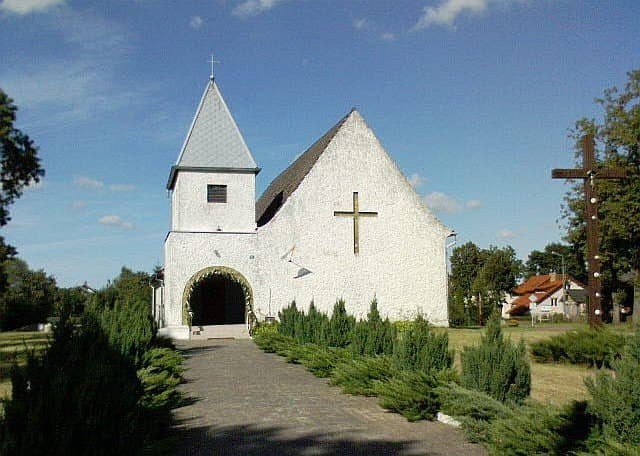
Grzegorz W. Tężycki, Wikimedia Commons, CC BY-SA 4.0
For sixteen years, from 1880 to 1896, a family estate – and the only one not bought but knocked down at a forced sale. Because it went again in 1896 it is missing from every later survey; only the land register of the Körlin court brings it back.
Chronicle
- 1787–18501787–1850
Before the family
The land register carries the owners back into the eighteenth century: a widowed Landrat’s wife whose husband made his will in 1787, then three purchases in 1793, 1805 and 1806, and after that the Schünemann family. On 19 December 1849 the manorial lordships of Rabuhn and Moitzlien conclude a division of the commons; the Royal General Commission at Stargard confirms it in 1850.
19 November 1874
The land register is carried over onto the new form. Its first owner is Lieutenant Carl Müller, who took the estate over by contract of sale of 26 June 1874 and deed of cession of 6 October 1874; the entry is made on 27 January 1875. The value column gives 675,000 marks.
- 3 May 18803 May 1880
The knock-down
Six years after Müller’s purchase Rabuhn comes under the hammer, and it is knocked down to “the Landrat von Gerlach of Cöslin” – August Friedrich Bernhard von Gerlach-Parsow (1830–1906). The purchase money is deposited on 3 June, the judge in the forced sale applies on the same day, and on 15 June 1880 the name stands in the book. The price: 315,500 marks, not even half what Müller had paid. It is the family’s only acquisition out of a forced sale.
- 1884–18931884–1893
The printed record
The Handbuch des Grundbesitzes im Deutschen Reiche (1884) lists “Gerlach, v., L.-R.” with Cöslin, Parsow, Schwemmin, Drosedow, Rabuhn and Trienke. The Adressbuch aller Länder der Erde (1891) puts it tersely: “Rabuhn (Ramelow): v. Gerlach” – Ramlewo being the post town. The Brünn Genealogisches Taschenbuch der adeligen Häuser (1892) names August as holder of the Parsow and Schwemmin entail “and of the manors Trienke, Rabuhn and Drosedow”; Janecki’s Handbuch des Preußischen Adels (1893) repeats it. A wool market report of the same years lists “Rabuhn-Pommern” among the preferred estates whose wool fetched 84 to 87 marks.
5 September 1896 · The departure
Conveyance and entry fall on one day: the manorial owners von Gaudecker of Kerstin and of Rabuhn take the estate over. Two years later, on 14 October 1898, the Landbank company of Berlin stands in the book – the usual road to parcelling out. In 1900 the estate owner Otto Ebert follows, in 1909 the farmer Oskar Ebert. From then on Rabuhn is a name with no family connection, and that is why it is absent from every survey written after 1900.
- 19371937
What became of the estate. The write-offs in the schedule of parcels show the fields going sheet by sheet: parcel after parcel transferred to other register sheets, a part certified by the land settlement office in October 1936 as agricultural settlement land and newly entered on 28 January 1937. The manor becomes a village of smallholdings.
- TodayToday
Rabuhn is called Robuń and lies in the Gmina Gościno in the Kołobrzeg county. Until 1945 the parish of Rabuhn also included Moitzlin, today Myślino. Source for the whole succession of owners: land register of the Rabuhn estate, volume I, sheet 1 – Archiwum Państwowe w Koszalinie, fonds 26/143 (district court of Karlino), call number 26/143/0/2.1/177; beside it the volume of the village’s peasant holdings, 26/143/0/2.1/178.
Location on the map
Loading map…
Places on the map (text list)
- Rabuhn estate — Robuń, gmina Gościno, PL — 1880–1896 (Estate (family property))
The Pomeranian and Neumark estates and Plutowo are today on Polish territory and passed out of family ownership in the 1945 expulsions; Vollenschier lies in the Altmark. Nienburg on the Saale is not an estate but one of the family’s places of origin in Germany.