
Gut Vollenschier
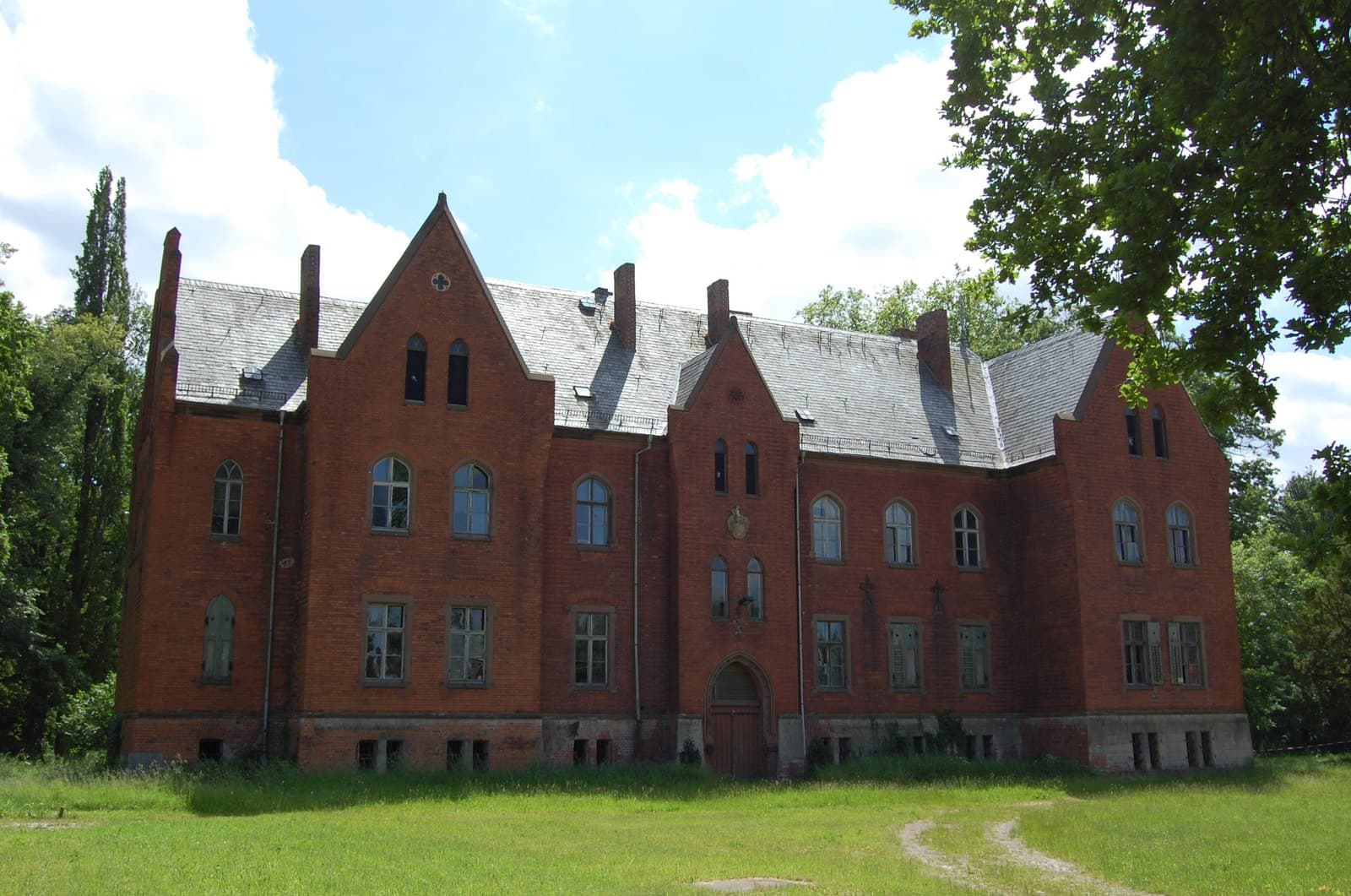
Olaf Meister, Wikimedia Commons, CC BY-SA 3.0
The place he was named after. In the official gazettes and newspapers around 1900 Jakob von Gerlach appears as “von Gerlach-Vollenschier”, just as his cousin was “von Gerlach-Parsow” – and as with Plutowo it was a Kröcher estate, of which he owned a half and which he could not pass on. Here he lived as a widower, and here he lies buried.
Chronicle
- before 1854before 1854
The von Bornstedts
Before the von Kröchers the von Bornstedts sat at Vollenschier. The Saxony-Anhalt State Archives keep a file “The Vollenschier estate of the von Bornstedt family” and a second on “boundary disputes between v. Bornstedt of Vollenschier and Staats” – Staats being the neighbouring village. The succession of the estate is thus traceable across three families.
the buyer
Who bought Vollenschier for the von Kröchers is told by the same family history. It was Friedrich Wilhelm Carl von Kröcher, the Landesdirektor of the Altmark – the same man who owned Plutowo. The book lists his acquisitions in order: first Vinzelberg, Deetz and Käthen, which his father-in-law had bought for him and which he took over in 1817, then Falenczyn and Gluchowo in the Culm country, and “at a later time” in the Altmark the estate of Vollenschier and the Kröpelwarthe, along with a forest district near Sichau. So one man held both the Altmark and the West Prussian estate, and both later passed to his youngest daughter and her husband.
- since 1854since 1854
The von Kröchers
The Brünn pocketbook lists Vollenschier in the von Kröcher article among that house’s possessions: “in the Altmark: Vinzelberg (since 1817, now an entail), Vollenschier (since 1854, allodial estate)”. Vinzelberg, the seat of this line, lies two and a half kilometres to the north.
- 1858–19361858–1936
Entail and allodial land
Why a daughter could bring Vollenschier and Plutowo into a marriage but not Vinzelberg is recorded in a file of the Prussian ministry of justice: “The entail established by the provincial director von Kröcher at Vinzelberg”, running from 1858 to 1936 (Secret State Archives, I. HA Rep. 84a no. 45084). Vinzelberg was tied and descended in the male line; Vollenschier and Plutowo the Brünn pocketbook expressly calls “allodial estates”, that is, freely heritable. The difference between the two forms of tenure decided what entered this marriage and what did not.
- 25 June 186125 June 1861
The first record
The Staats-Anzeiger announces the appointment of the “Landraths-Amts-Verwesers, Gerichts-Assessors Jakob von Gerlach auf Vollenschier” (acting Landrat, court assessor Jakob von Gerlach of Vollenschier) as Landrat of the Gardelegen district. Five months after his father-in-law’s death on 12 January 1861 he is already styled “of Vollenschier” – the transfer out of the Kröcher estate must have taken place in those months.
- 18691869
The Schloss
In this year the building went up that the monument list calls Schloss Vollenschier: unrendered brick in neo-Gothic forms, two full storeys and an attic above a high plinth, stepped gables, pointed-arch windows, an armorial stone over the doorway. The designer was Conrad Wilhelm Hase of Hanover, founder of the Hanover School; the client was August von Kröcher. The red bricks came from the estate’s own brickworks. The older, rendered manor house of the mid-eighteenth century remained standing beside it.
- 1875 to 18771875 to 1877
The estate church
The same client and the same architect built the church in which Jakob von Gerlach would later be buried: foundation stone 1875, consecration 1877, churchyard wall and gate by 1878. In 1876 the “Archiv für kirchliche Baukunst und Kirchenschmuck” published it on nine plates with a full description. The church was built for the lord of the estate and his people, and the seating kept the two apart: first the family, then the inspector and the steward, then the people, for whom a hundred and twenty-one places were provided. The family pew lies at the level of the chancel, has its own entrance and is, in the words of the account, “kept as far as possible out of the people’s sight”. Inside, the church is 18.7 metres long and 12.2 wide; without its fittings it cost some thirty thousand marks.
- 18761876
The altar
Hase drew the altar himself and explained it in the same volume of the same journal. Above the table stands the Crucified within a wheel of tracery, at his feet the four Old Testament sacrificial types Abel, Melchizedek, Isaac and Aaron, at the ends of the cross four kings of the house of David; on the antependium the Lamb bears the banner of victory between Alpha and Omega. It was executed by the Heinersdorff works for church ornament in Berlin for about nine thousand marks. It was meant for the Munich applied arts exhibition; the detail drawings were not finished in time.
Two sheets in Vienna
How the church was drawn is preserved in Vienna. The MAK, the Museum of Applied Arts, holds in its print collection two photolithographs of the Vollenschier estate church, made in Berlin, 22.9 by 26.2 centimetres, under the numbers KI 16459-16 and KI 16459-17. They are the only known architectural drawings for a building of the family. We may not show them: the museum lists them as in copyright.
- 2 April 18892 April 1889
The brother-in-law
On this day August Hennig von Kröcher died in Berlin, privy senior councillor of government (retired), latterly a reporting councillor in the ministry of the interior and from June 1865 to March 1873 a member of the House of Lords, in his seventy-second year. He was the client for both Schloss and church and held the other half of the estate. The obituary list of “Der deutsche Herold” names his siblings: his brother Wilhelm, a district administrator (retired), and his sisters Ehrengard, widowed von Alvensleben, Agnes, and Sophie, married to Jakob von Gerlach. That settles what could previously only be supposed: Udo von Alvensleben’s wife was a sister of Jakob’s wife.
- 18921892
The Brünn pocketbook
The Brünn Genealogisches Taschenbuch der adeligen Häuser, volume 17, lists him as “co-owner of the Vollenschier estate in the Altmark (one half) and owner of the Plutowo estate” – a half, then, not the whole; the other half stayed with the von Kröchers.
- 1894 and 18961894 and 1896
Marienbad
The Bohemian spa lists carry him twice, in 1894 “with his wife, from Vollenschier”, in 1896 at the Friedrich Wilhelm foundation house. The place-name stands in the lists where others have a town – for the spa administration Vollenschier was his address.
- 1899 to 19071899 to 1907
The name in the gazette
In 1899 the Reichsanzeiger lists “Frau Privy Councillor von Gerlach, née von Kröcher of Vollenschier” among those decorated; in 1901 the “Privy Councillor and Landrat (ret.) at Vollenschier” receives 11,400,604 votes in the election to the Imperial Insurance Office; in October 1903 the “Landrat (ret.) von Gerlach-Vollenschier” speaks at the general synod against the proposition that duelling is sin; in January 1904 “Privy Councillor von Gerlach, Vollenschier” signs the appeal for the social work of Protestant Christendom; in 1907 “von Gerlach of Vollenschier” receives the Red Eagle Order third class with bow.
- 27 June 190827 June 1908
The commercial register
The district court of Berlin-Mitte enters the new statutes of the Berlin Missionary Society. At the head of the board stands “Privy Councillor Jakob von Gerlach at Vollenschier”. It is the last official entry under his name in his lifetime (Deutscher Reichsanzeiger, 6 July 1908).
29 November 1908 · The grave
On the first Sunday of Advent Jakob von Gerlach is buried at Vollenschier, three and a half years after his wife. The memorial address is given by his nephew, Pastor Martin von Gerlach of Silberhammer, the final blessing by Pastor Albrecht-Staats. As a widower he had lived on the Kröcher estate (Hallesche Zeitung, 3 December 1908, after the Kreuzzeitung).
- 19081908
The administration changes hands
From the year of his death the Erxleben estate archive holds a file “Administration of the Vollenschier estate”, dated 1908 (Saxony-Anhalt State Archives, H 66 no. 4044). It is filed there among the “other estates of the von Alvensleben family” – where Vollenschier belonged through Sophie von Kröcher née Countess von Alvensleben. What was settled that year is in this file.
- TodayToday
Vollenschier is a part of the Hanseatic town of Stendal and belongs to the locality of Wittenmoor; until 2010 it was a part of the separate municipality of Wittenmoor. Vinzelberg, where the marriage of 1858 took place, lies two and a half kilometres to the north. Schloss, manor house, church, churchyard gate and the old school still stand together – a complete piece of the Hanover School in the middle of the Altmark.
Images
2010The older manor house, built in the middle of the eighteenth century and lived in to this day. It stands beside the Schloss of 1869 and is often confused with it: yellow render instead of red brick, classicist instead of neo-Gothic.
Olaf Meister · Wikimedia Commons · CC BY-SA 3.0
2010The estate church. Here Jakob von Gerlach was buried on the first Sunday of Advent 1908, three and a half years after his wife; his nephew Martin gave the memorial address.
Olaf2 · Wikimedia Commons · CC BY-SA 3.0
1876This is how the church was conceived: the west elevation from the “Archiv für kirchliche Baukunst und Kirchenschmuck” of 1876, plate 8, signed by Conrad Wilhelm Hase. The accompanying article praises the brick from the estate’s own works and notes that only the plinth and the steps are of erratic boulder and sandstone.
Conrad Wilhelm Hase, Archiv für kirchliche Baukunst und Kirchenschmuck, vol. 1, 1876, sheet 8 · Munich Digitization Centre · public domain
1876The altar, designed by Hase and described by him. Below stand Abel, Melchizedek, Isaac and Aaron, at the ends of the cross four kings of the house of David, on the antependium the Lamb with the banner of victory between Alpha and Omega. Its execution was to cost nine thousand marks.
Conrad Wilhelm Hase, Archiv für kirchliche Baukunst und Kirchenschmuck, vol. 1, 1876, sheet 21 · Munich Digitization Centre · public domain
Location on the map
Loading map…
Places on the map (text list)
- Vollenschier estate — Vollenschier, part of the Hanseatic town of Stendal (Wittenmoor), Stendal district, DE — 1861–1908 (one half) (Estate (family property))
The Pomeranian and Neumark estates and Plutowo are today on Polish territory and passed out of family ownership in the 1945 expulsions; Vollenschier lies in the Altmark. Nienburg on the Saale is not an estate but one of the family’s places of origin in Germany.