
Zeblin Estate
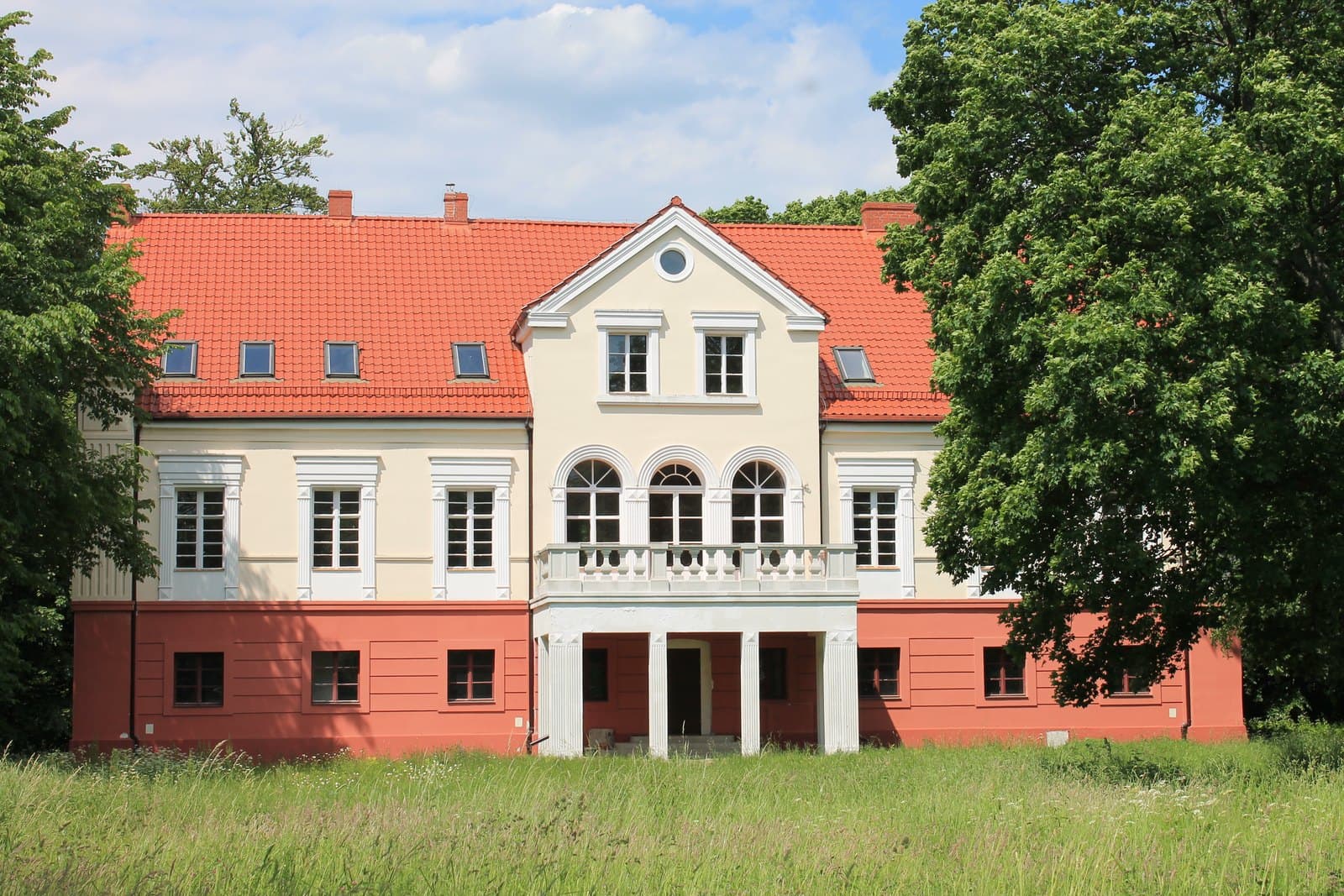
Krygor, Wikimedia Commons, CC BY-SA 4.0
Major Otto Lebrecht von Gerlach bought Zeblin on 27 July 1762 from Johann Carl Birkholz, who had been refused the sovereign’s consent to hold it, and kept it until his death; afterwards it belonged to his daughter, who had married a Danzig merchant. Zeblin is also the birthplace of Ewald Christian von Kleist, the poet of “Spring”, and the buyer’s bride was a born von Kleist – from the neighbouring house of Schönau, not from Zeblin, as the family history of 1903 suggested. The manor house, the park and the octagonal burial chapel of 1662 still stand.
Chronicle
until the 16th century
Zebbelin, as the charters write it, had been a fief of the Knuth family since a time no record names. The vassal table of 1565 lists “Jaspar and his brothers the Knuttenn” as seated there; in 1572 Ansam and Claus Knuten of Zebelin appear. Their family, Berghaus says, never spread far.
- 16301630
The successors are the von Kleist family; Jürgen Kleist in particular is named as owner of this estate. From their time the octagonal burial chapel still stands in the park, a half-timbered building with a shingled tent roof and lantern, which Christiane von Kleist had built in 1662 according to its inscription.
- 7 March 17157 March 1715
A poet
In the manor house at Zeblin, Ewald Christian von Kleist was born, the poet of “Der Frühling”. He became a major in Prince Henry’s regiment, was mortally wounded at Kunersdorf and died on 24 August 1759 at Frankfurt an der Oder. Three years after his death a von Gerlach moved into the house in which he had been born.
- 1735 to 17591735 to 1759
A chain of mortgagees
Joachim Ewald von Kleist sold Zeblin in 1735 on a thirty-year repurchase agreement to Captain Hans Paul von Humboldt, grandfather of Wilhelm and Alexander. From him it passed on 2 March 1739 to Heinrich Ludwig von Meseritz, and on 15 April 1744, for the remaining term, to Peter von Puttkamer. His widow Barbara Marie née von Heydebreck and Lieutenant Christian Ewald von Kleist – the poet – ceded their rights on 4 January and 18 February 1748 to Captain Matthias Reimar von Kleist. After his death his widow Christiane Marie née von Redern sold the estate on 26 August 1757 to Captain Johann Joachim von Kleist, who on 24 December of the same year mortgaged it for twenty-five years to Curt Heinrich von Wussow; he in turn ceded his right on 12 May 1759 to Johann Carl Birkholz.
- 27 July 176227 July 1762
The purchase
Because Birkholz could not obtain the sovereign’s consent to hold the estate, he ceded and sold it on 27 July 1762 to Major Leberecht Otto von Gerlach. The contract of sale is dated at Zeblin itself. Otto Lebrecht von Gerlach was then forty-one, had served twenty-one years in the cavalry and had taken his discharge two years earlier; his wife Anna Sophia was a born von Kleist from the house of Schönau, not half a mile away. He was therefore buying a Kleist estate six years after marrying a Kleist.
7 May 1764 and 22 May 1765
Landrat Hans Joachim von Kleist ceded his feudal right in Zeblin to him on 7 May 1764. On 22 May 1765 the von Kleist family was precluded from its rights of pre-emption and redemption – the estate was out of their hands for good. The same Hans Joachim von Kleist had four months earlier, on 17 January 1765, sold the estate of Schwemmin to Friedrich Wilhelm von Gerlach, the major’s brother. Two brothers, two Kleist estates, three years apart.
- 17841784
Pledged
Brüggemann, who described the Pomeranian estates from the files, finds it in other hands: the major had pledged it to David Knack, who still held it in 1784. Before the end of the eighteenth century he redeemed it again. No source says why it was pledged.
after the major’s death · A daughter
What happened next is the most surprising piece of news in this estate’s history. “After his death it was owned by his daughter, the wife of the Danzig merchant Pfloeger, to whom it had been credited at a value of 10,000 thalers in the settlement of the estate,” writes Berghaus. The printed Gerlach family history of 1903 knows only two sons from this marriage, both of whom died before their father. So there was a daughter as well; she outlived him, she married into Danzig and she inherited the estate. Her name was Sofie Leopoldine, born at Stargard on 4 May 1760; the handbook of 1893 spells her husband’s name “Pfegel”, Berghaus “Pfloeger” – the Danzig burgher register must decide.
- 1830 and 18621830 and 1862
In 1830 Zeblin passed to Landschaftsrat von Hellermann, who took up residence there; his heirs are, as Berghaus writes in 1862, the owners of Zeblin and of the two Viverow estates. With that the family’s connection with the estate ends.
- about 1862about 1862
What the estate looked like
Berghaus described it in his Landbuch of Pomerania. An allodial estate with a chapel, one mile north of Bublitz, on and against the high steep edge of the Radüe valley, together with the Laubkrug on the road from Köslin to Baldenburg and the water mill on the Radüe on the highway from Bublitz to Pollnow. Twenty-six dwellings, among them the manor, the school and a village headman’s house, twenty-six farm buildings and two buildings in the village serving manufacture. The chapel was a chapel of ease of the mother church in nearby Kurow. Two hundred and thirty-seven inhabitants in thirty-seven families – three tenants, farm assistants, servants and the estate’s day labourers. The fields measured 3,525 Morgen: 2,000 of arable in a six-course rotation, 180 of two-cut irrigated meadow whose fifteen years of use had “well justified” the outlay, 40 of gardens, 1,259 of woodland of pine, beech and oak, and 46 of yards, roads and waste. The stalls held thirty-one horses, ninety-seven cattle, 1,330 half-improved and 114 coarse sheep, forty pigs and six goats. Eel fishing in the Radüe was slight; along the river lay meadow lime and peat, and marl in the fields.
- 1885 and 18921885 and 1892
The successors
The family to which Zeblin passed can be followed two generations further. In September 1885 the papers list among the dead “Herr Ulrich v. Hellermann of Zeblin”. Seven years later his successor on the same estate enters the Landtag: in October 1892 “the lieutenant colonel retired and landowner von Hellermann of Zeblin (conservative) was elected unanimously with 196 votes to membership of the House of Deputies”, in place of the late director of the provincial credit association von Holtz; there was no opposing candidate. He had been put up a month earlier in place of Count Kleist-Schmenzin. It is the same constituency of Kolberg-Körlin and Bublitz in which, three years later, August von Gerlach-Parsow fought for his Reichstag seat.
- 1898 to 19021898 to 1902
The address and the death
Two passages in the yearbook of the Society for Pomeranian History and Antiquities round off the estate’s history after our own period. The membership list has, under number 676, “von Hellermann, lieutenant-colonel (ret.)”, and gives his address in full: “Zeblin near Curow, district of Bublitz”. That also fixes the administrative position of the place – between 1816 and 1932 it belonged to the district of Bublitz, while the canton register of 1734 still lists it under the district of Köslin and, before 1817, under the principality of Cammin. The same man, elected in 1892 to the Prussian house of deputies for the Kolberg-Körlin–Bublitz constituency, died in the business year April 1901 to April 1902: the society’s sixty-fourth annual report names him among the dead, “lieutenant-colonel (ret.) von Hellermann of Zeblin”.
The Danzig trail
Two questions lead to the files: the spelling of the husband’s name – “Pfegel” in the handbook of 1893, “Pfloeger” in Berghaus – and the end of the Gerlach tenure, which falls between the major’s death in 1798 and the year 1830. The feudal and mortgage records of the Fürstenthum district and the Danzig registers hold the answers.
1750, 1879 and today
The present manor house is late classicist and dated to 1750; in 1879 it was rebuilt and given its present form. It stands on a rectangular plan, has an upper storey and a gabled roof; the nine-bay façade carries a three-bay central projection with a triangular pediment, and below it a terrace resting on columns. With it goes a landscape park of 5.62 hectares containing the von Kleist burial chapel of 1662. The ensemble has been a listed monument since 25 March 1977 (register no. 963); today it belongs to private owners who have restored it. In 1945 the house and chapel were stripped; what survived is the original sixteenth-century chapel door, now in the museum at Koszalin.
Images
2014The burial chapel of 1662 in the park – half-timbering, a shingled tent roof, a lantern.
Krygor, Wikimedia Commons, CC BY-SA 4.0
2014The estate buildings seen from the fields.
Krygor, Wikimedia Commons, CC BY-SA 4.0
2014The landscape park of 5.62 hectares in which the chapel stands.
Krygor, Wikimedia Commons, CC BY-SA 4.0
Location on the map
Loading map…
Places on the map (text list)
- Zeblin manor estate — Cybulino, gmina Bobolice, PL — 1762–1830 (Estate (family property))
The Pomeranian and Neumark estates and Plutowo are today on Polish territory and passed out of family ownership in the 1945 expulsions; Vollenschier lies in the Altmark. Nienburg on the Saale is not an estate but one of the family’s places of origin in Germany.